

Tbilisi State Medical University is further strengthening its position as a regional and international center for medical education. The University’s Centre for Experimental Morphology and Anatomical Dissection Skills is developing into a multidisciplinary international training hub, offering students and practicing medical professionals from Georgia and abroad opportunities to enhance their practical skills through hands-on training using human cadaveric specimens. The strategic objective of TSMU is to establish the Centre as a leading platform in the region, offering training in advanced surgical techniques, laparoscopic anatomy and clinical dissection under the guidance of internationally renowned mentors.
Professor Irakli Natroshvili, Rector of Tbilisi State Medical University:
"The primary mission of the Centre for Experimental Morphology and Anatomical Dissection is to strengthen education in this field and provide opportunities for practical training in accordance with contemporary standards. I am particularly proud to note that, after a 40-year hiatus, this type of training has been reintroduced at Tbilisi State Medical University. Many higher medical education institutions worldwide, particularly in Eastern Europe, do not have the facilities to offer training in experimental morphology and anatomical dissection. In Georgia, TSMU is the only higher medical education institution providing this type of training. This is an opportunity of which I am extremely proud and which further demonstrates Tbilisi State Medical University's leadership in the advancement of medical education. Our vision is primarily centered on the needs of our students. The Centre will first and foremost serve TSMU students, providing them with the opportunity to work with real human anatomical material, deepen their knowledge and develop practical skills that are essential in contemporary medicine. At the same time, we aim to make the Centre an important professional development venue for practicing physicians, offering cadaveric courses in various medical specialties. Together with our partners, Tbilisi State Medical University will host its first international course of this kind on September 18–19. The course will focus entirely on Maxilla-For-All protocols and contemporary implantology and maxillofacial surgical techniques, with the participation of internationally recognized mentors. In the future, the Centre plans to offer courses in various fields, including neurosurgery, gynecology, endoscopic surgery and other specialties. The relevant syllabi are already under development, and the courses will be delivered by Tbilisi State Medical University. Our goal is to establish the Centre for Experimental Morphology and Anatomical Dissection as an international hub – a platform for contemporary cadaveric training, practical skills development and the exchange of international expertise. I am confident that there will be considerable demand for this type of training, both in Georgia and across the wider region, and that TSMU will become an important international center in this field”.
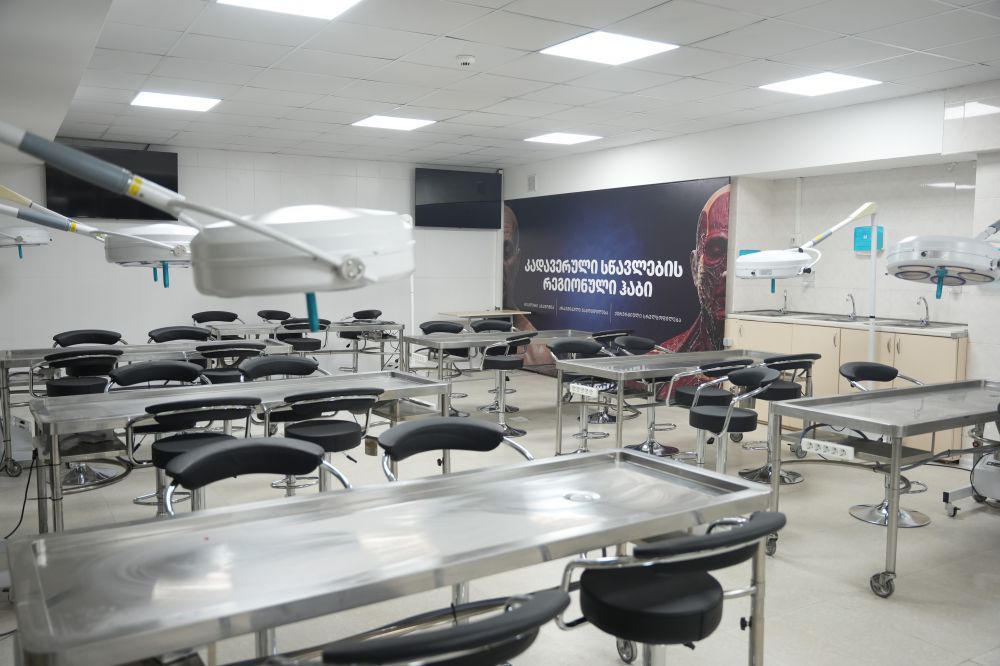
To develop the Centre into a hub meeting international standards, the University has upgraded its material and technical infrastructure. TSMU has equipped the Centre with state-of-the-art technologies essential for anatomy, clinical and surgical anatomy, and morphological diagnostics.
Associate Professor David Topuria – Director of the TSMU Centre for Experimental Morphology and Anatomical Dissection Skills, Dean of the International Faculty of Medicine and Stomatology:
“The Centre has been equipped with state-of-the-art multifunctional dissection tables designed for the detailed examination of individual organs and anatomical regions. These tables have no equivalent in Georgia's educational sector. The Centre has also acquired a multifunctional refrigerated storage facility that enables cadavers to be preserved without toxic substances and without freezing the tissues. This makes it possible to study both the macroscopic and microscopic anatomical structures of the human body in their natural state. The Centre is equipped with all the technical facilities required for anatomy, clinical anatomy, laparoscopic anatomy, morphological diagnostics and surgical anatomy."
International Cadaveric Course Series to Launch on September 18–19
The TSMU Centre for Experimental Morphology and Anatomical Dissection Skills is moving into its practical implementation phase and beginning in September will host a series of international cadaveric courses in collaboration with its partners.
On September 18–19, 2026, the Centre will host an international training course organized within the framework of a partnership between Tbilisi State Medical University, JDentalCare and the Caucasus Institute for Surgical Anatomy (CISA).
The course will focus exclusively on Maxilla-For-All protocols and contemporary implantology and maxillofacial surgical techniques. Participants will have the opportunity to undertake practical training using human anatomical material and become familiar with modern approaches implemented in European clinical practice. The course will be led by invited trainers from Italy: Dr Filippo De Paolis and Dr Manuel Mingione, both internationally recognized mentors in the management of atrophic jaws.
Nino Jakhveladze – Executive Director of the TSMU University Dental Clinic:
“The primary objective of the course is to provide participants not only with theoretical knowledge but also with practical expertise in contemporary approaches to the management of atrophic jaws. It is particularly important for clinicians to become familiar with modern protocols that enable them to manage severe cases of jaw atrophy, including cases of complete atrophy, effectively and, in certain circumstances, avoid the need for bone grafting. One of the major advantages of these approaches is the substantial reduction in treatment time. With conventional methods, patients may sometimes have to wait more than a year for bone augmentation and implant placement. However, when modern protocols are applied appropriately, selected clinical cases may allow patients to regain both functional and aesthetic outcomes – a new smile – within as little as 72 hours. Interest in the project was exceptionally high from the outset. In addition to Georgian dentists, international specialists also expressed their interest in participating in the course, further highlighting the importance of this modern, practice-oriented educational format. Our goal is to establish Tbilisi State Medical University as a regional hub for cadaveric training and to create a platform for Georgian and international specialists to share contemporary international expertise and best practices.”
Avtandil Abdushelishvili – Founder of the Caucasus Institute of Surgical Anatomy (CISA):
“Hands-on training based on real human anatomy enhances clinicians’ professional precision and confidence, reduces the risk of complications and ultimately contributes to patient safety. This is precisely why CISA was established as a full-body cadaveric training center serving a range of medical and surgical specialties. Our goal is to ensure that Georgian physicians no longer need to travel abroad regularly to access high-quality practical medical education. We want them to have access to international mentors, the latest advances in medicine, modern surgical techniques and hands-on training opportunities in their own country. The arrival of leading specialists from across the region and Europe in Georgia will facilitate knowledge exchange, foster new professional connections and support the integration of contemporary medical approaches into local practice. CISA attaches particular importance to its collaboration with Tbilisi State Medical University. We have an exclusive partnership with the University in the field of cadaveric training, which provides an essential foundation for the Institute’s development and the design of educational programmes aligned with international standards. Tbilisi State Medical University is an institution with a long-standing tradition of excellence in medical education, strong academic resources and an established international reputation. Therefore, the support and direct involvement of a university of this caliber are particularly valuable to us. This partnership brings together the University’s academic knowledge and expertise, CISA’s vision and organizational capacity, creating a solid foundation for the systematic development of contemporary cadaveric training in Georgia. We believe that this partnership will enable us not only to deliver high-quality professional training programmes but also to position Georgia as an important center for surgical education in the Caucasus region. Our vision has been regional from the outset. Georgia has genuine potential to become a major center for medical education and practical training in the Caucasus. The country’s geographical location, strong medical tradition, experienced physicians and potential for international cooperation provide a solid basis for attracting medical professionals from neighboring countries and the wider region to pursue training in Georgia. We want physicians to come to Georgia to receive the same standard of practical education for which they currently often travel to training centers in Europe and the United States.”
A cooperation agreement between the Dental University Clinic of Tbilisi State Medical University (LEPL) and the Caucasus Institute of Surgical Anatomy (CISA) (LLC) was signed on June 22, 2026. The agreement was signed on behalf of the Clinic by its Executive Director, Nino Jakhveladze. Under the agreement, the two institutions plan to jointly organize cadaveric training courses at Tbilisi State Medical University in various specialties, including plastic surgery and aesthetic medicine, orthopedics and traumatology, maxillofacial surgery, cardiovascular and thoracic surgery, neurosurgery, and general and laparoscopic surgery. The partnership also envisages the expansion of international educational cooperation. A memorandum of understanding between TSMU and Tommaso Grandi Education is also planned. Within this framework, theoretical and practical training programmes in implantology are to be delivered in Georgia, accompanied by live demonstrations of clinical surgical procedures. These programmes will provide participants with opportunities to gain practical experience in contemporary implantology techniques and the management of complex clinical cases. The partnership aims to promote the exchange of international expertise, advance practical medical education and strengthen the professional competencies of medical practitioners.