


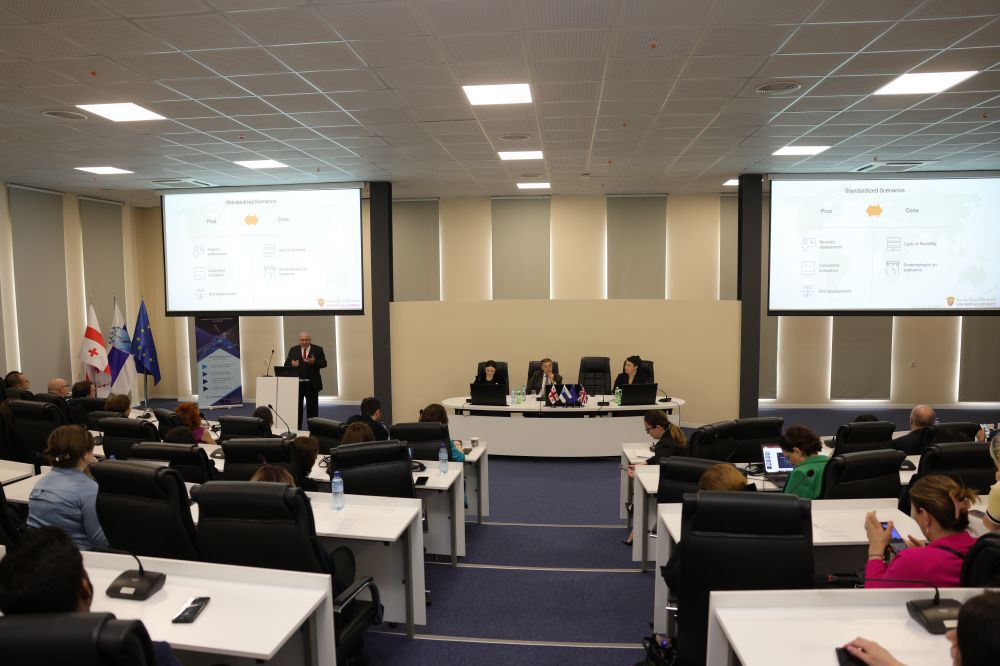
Tbilisi State Medical University hosted the final conference of the project "Implementation of OSTE Stations in Georgian Higher Education Institutions." The event aimed to promote innovative methods in teaching and learning, as well as to review the outcomes achieved through the project.
The conference was opened by Professor Irakli Natrosvili, Rector of TSMU. The opening remarks were delivered by Tamar Ghvamichava, Deputy Minister of Education, Science and Youth of Georgia and Tamar Sanikidze, Executive Director of the World Bank-funded project Innovation, Inclusion and Quality (I2Q) in Georgia.
The TSMU Rector highlighted that Objectively Structured Teaching Encounter (OSTE) enhances both teaching methodologies and faculty-student communication, as well as develops teachers’ essential professional skills.
The event brought together international and local experts, representatives of participating universities and key stakeholders in education policy.
A special guest of the conference was Dr. David Taylor, Director of the Gulf Medical University Center for Leadership and Innovation in Health Professions Education, who delivered a keynote address focusing on OSTE as a robust methodology for objective assessment in medical education.
The project "Implementation of OSTE Stations in Georgian Higher Education Institutions" was the winner of the Competitive Innovation Fund (CIF) grant competition and funded by the World Bank. It was jointly implemented by Tbilisi State Medical University and the School of Medicine of the Georgian-American University.
One of the primary objectives of the project is to enhance academic staff's teaching techniques and interpersonal communication skills, thereby supporting their ongoing professional development. Additionally, the initiative seeks to establish modern, competency-based teaching approaches as tools for academic advancement—an essential element for the effective implementation of a modernized, integrated curriculum.
.jpg)
.jpg)
.jpg)
.jpg)
.JPG)
.JPG)
.JPG)
.JPG)
.JPG)
.JPG)
.JPG)
.JPG)
.JPG)
.JPG)
.JPG)
.JPG)
.JPG)
.JPG)
.JPG)
.JPG)
.JPG)
.JPG)
.JPG)
.JPG)
.JPG)
.JPG)
.JPG)
.JPG)
.JPG)
.JPG)
.JPG)
.JPG)
.JPG)
.JPG)
.JPG)
.JPG)
.JPG)
.JPG)
.JPG)
.JPG)
.JPG)
.JPG)
.JPG)
.JPG)
.JPG)