

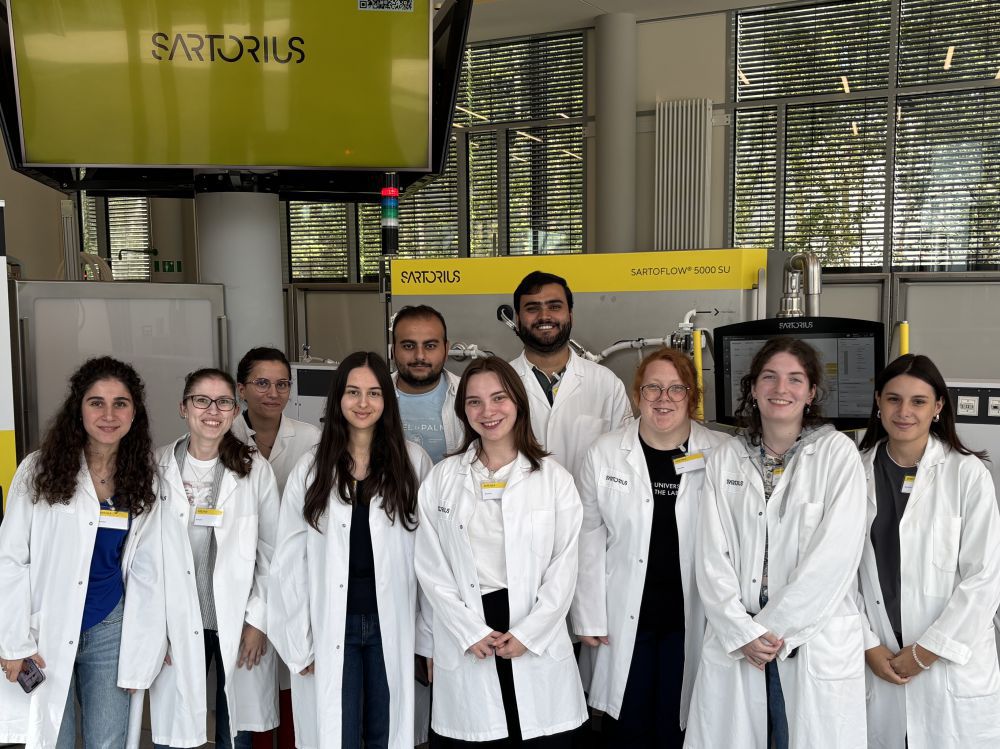
Tbilisi State Medical University students gained experience in an international academic and clinical environment in Germany through the German Academic Exchange Service (DAAD) programme. The students participated in the LISA – Lower Saxony International Summer Academy in Infection & Immunology, held in Hanover at one of Germany’s leading medical and research centers.
From Lectures to Research Laboratories
The programme combined lectures on contemporary immunology and infectious diseases with scientific discussions, poster presentations and laboratory rotations.
TSMU students had the opportunity to connect theoretical knowledge with contemporary research methods, gain hands-on laboratory experience and interact with students and researchers from different countries while exploring their professional potential in an international setting.
“For me, the most valuable aspect was the opportunity to connect my medical education with research and scientific practice. I was introduced to techniques such as flow cytometry (FACS), SDS-PAGE, and Western blotting. The visit to Sartorius’ headquarters in Göttingen was also particularly interesting, as it gave me a deeper understanding of the relationship between academic research and modern biotechnology,” said Glikeria-Iliana Kiknadze, a sixth-year medical student of TSMU.
Experiments and Contemporary Laboratory Techniques
Reflecting on her experience in Germany, Nia Bolashvili, an 11th-semester medical student of TSMU, emphasized that the programme’s greatest value lay in the opportunity to participate directly in laboratory research.
“The most valuable part of the experience for me was the hands-on laboratory work. I undertook placements in the research laboratories of the Leibniz Institute for Biotechnology and Artificial Organs, as well as in experimental oncology and hematology, where I had the opportunity to conduct experiments using a range of techniques,” Nia Bolashvili noted.
The TSMU student’s work involved stem cell differentiation, exploring the use of 3D organoids in research, and applying techniques such as quantitative polymerase chain reaction (qPCR), flow cytometry, and Western blotting. She noted that the programme allowed her to apply methods she had previously studied in theory in a real-world research environment.
Another area of contemporary scientific research that particularly impressed the TSMU students was stem cell research and the modelling of diseases at the cellular level.
“The most impressive was the work involving advanced stem cell research. It was particularly fascinating to see how induced pluripotent stem cells (iPSCs) can be used to model diseases, support research, and potentially contribute to the development of new therapeutic approaches. I was also interested in the research involving cisplatin. During the experiences I realized that knowledge acquired through lectures or textbooks takes on a whole new dimension when applied to actual research, said Mariam Papava, an 11th-semester medical student of TSMU.
Research and Critical Thinking
Exposure to a research environment helped students recognize the importance of scientific reasoning, data evaluation and critical thinking.
“At university, we are mostly focused on established findings but during the internship, however, I saw how much work, time, and attention to detail are required to achieve reliable scientific results. One of the most important lessons for me was realizing that even seemingly minor details matter in research. Even a small error can affect the results,” said Nino Dilsizi, an 11th-semester medical student of TSMU.
Ketevan Chikovani, TSMU student noted, one of the most valuable aspects of the programme was gaining a deeper understanding of the importance of critical thinking and how clinical experience can be translated into a scientific research project.
“The most important takeaway was understanding just how essential critical thinking is in medicine. I gained a clearer understanding of how clinical experience can be transformed into a scientific research project. Communicating with people from different fields was also extremely valuable, as it helped me become more confident. I learned never to be afraid to express my opinions,” Ketevan Chikovani noted.
She also highlighted teamwork, communication with professionals from diverse disciplines, and the ability to present her ideas clearly as important skills developed during the programme. She believes these competencies will be valuable in her future professional career.
International Collaboration and Professional Networking
TSMU students noted that interacting with German students and colleagues helped them discover shared professional interests and establish new professional networks. They encourage other students to take advantage of similar opportunities and not to postpone applying simply because they feel they lack sufficient experience.
“I would encourage students to seize opportunities like this and not be afraid to apply, even if they feel they do not yet have enough experience. The key is to be proactive, ask questions, connect with people, and engage fully in the programme. Becoming an active participant rather than simply being an observer was one of the most important parts of the internship,” noted Ketevan Chikovani, one of the programme participants.
Research Excellence on the International Stage
An important component of the programme was the opportunity for students to present their scientific research to an international audience.
“The most exciting moment was presenting my research to an international audience and receiving recognition. Knowing that your work captures the attention of others is a tremendous source of motivation,” noted Ghlikeria-Iliana Kiknadze
At the LISA Summer Academy poster session, TSMU students Mariam Shalamberidze and Ghlikeria-Iliana Kiknadze received awards for the best research posters.
“At Hannover Medical School, all participants presented their research to an international audience. My colleague, Ghlikeria-Iliana Kiknadze and I were recognized for our presentations as the best research poster presenters. It was the most exciting and memorable moment of the programme,” said Mariam Shalamberidze, a 12th-semester medical student of TSMU.
Presenting her research to an international audience helped Mariam realize that establishing herself in the international scientific community is an achievable goal.
“The programme boosted my confidence, improved my communication skills and showed me that participating in the international scientific community is a realistic opportunity,” Mariam Shalamberidze added.
From International Experience to Future Career Aspirations
The internship in Germany offered students far more than academic and professional development. It enabled them to engage with peers and researchers from diverse backgrounds, gain intercultural experience and build valuable international networks for future collaboration.
“Participating in the programme showed me the importance of building friendly relationships with colleagues alongside professional ones. Exchanging knowledge and experiences with people from different countries and representing my own country also helped facilitate the development of professional connections,” said Nia Bolashvili.
TSMU medical student Mariam Sirbadze highlighted her experience in Professor Depliage’s laboratory, where she participated in tRNA nano sequencing. She described the experience as particularly memorable.
“The laboratory placed considerable emphasis on programming and computational analysis of experiments, which was entirely new to me and prompted me to reflect on the importance of biotechnology in laboratory research.
“I have a strong interest in basic sciences, research and laboratory work. Another particularly memorable experience during the internship was seeing cardiomyocytes derived from induced pluripotent stem cells. I believe this technology will be of tremendous importance to medicine and science in the future and I am delighted to have had the opportunity to observe it first-hand,” Mariam Sirbadze noted.
Nino Dilsizi also reflected on the value of the experience, highlighting her time in Hanover and the importance of international professional networks.
“Hanover brought us together with many young scientists from different parts of the world and new friendships began to form. These are the people who will contribute to scientific progress alongside you in the future,” Nino Dilsizi remarked.
The TSMU students also highlighted that their experience in Germany helped them clarify their professional interests and future career goals.
“This experience helped me realize that I genuinely want to pursue a career that combines medicine and scientific research,” said Ghlikeria-Iliana Kiknadze.
“The programme further reinforced my desire to make scientific research an integral part of my future medical career. I am particularly interested in immunology, genetics, cell biology and the development of new therapies,” noted Mariam Papava.
Students’ Advice: Seize the Opportunity
TSMU students have one key piece of advice for their peers: do not wait for the “right time” to apply, and make the most of available opportunities, even if you feel your experience is not yet sufficient.
“Give it a try, even if you initially feel you lack sufficient experience. Do not be afraid to ask questions, meet new people and challenge yourself. Simply attending lectures is not enough to make the most of a programme like this. Take every opportunity to engage with professors and researchers and participate directly in practical activities,” said Mariam Shalamberidze.
The students noted that the internship provided valuable new knowledge, practical skills, professional connections and most importantly, helped them view their future career paths from a new perspective.